
- Home
- OMG
- OMG Certification
- OMG-OCUP2-FOUND100
- OMG-OCUP2-FOUND100 - OMG Certified UML Professional 2 (OCUP 2) - Foundation Level
OMG OMG-OCUP2-FOUND100 OMG Certified UML Professional 2 (OCUP 2) - Foundation Level Exam Practice Test
OMG Certified UML Professional 2 (OCUP 2) - Foundation Level Questions and Answers
Choose the correct answer:
How many valid Action notations are shown below?

Options:
0
1
2
3
4
Answer:
DExplanation:
UML 2 Foundation concepts for activity diagrams, there are three valid action notations shown. Here's a breakdown of the elements and why answer D is the most accurate:
- The diagram displays an activity diagram with a main flow and a fork followed by a join.
- Main Flow: This starts with an action labeled "Fill Order".
- Fork: The path splits into two branches after "Fill Order".
- Branch 1: This branch leads to an action labeled "Print Paycheck".
- Branch 2: This branch leads to an action labeled "Send Invoice".
- Join: The two branches converge into a join element.
- Following the Join: An action labeled "End" is present after the join.
Explanation for Valid Actions:
- Fill Order: This clearly represents an action within the activity diagram.
- Print Paycheck: This is another valid action on a separate branch.
- Send Invoice: Similarly, this is an action on the other branch.
Explanation for Why Other Options are Incorrect:
- A. 0: There are clearly multiple actions depicted in the diagram.
- B. 1: There are more than one valid action shown.
- C. 2: While there are actions before the fork, there's also a valid action ("End") after the join.
- E. 4: Counting the join element as an action results in an overcount. Joins represent control flow elements to synchronize multiple paths, not actions themselves.
References
- UML 2.5.1 Specification (Superstructure): Sections on Activity Diagrams and Actions https://www.omg.org/spec/UML/2.5.1/
Choose the correct answer:
Which statement is correct regarding Enumeration Literals?
Options:
EnumerationLiterals are immutable
EnumerationLiterals may be anonymous.
EnumerationLiterals may not be compared for equality.
Enumeration Literal names may appear more than once within an Enumeration.
Answer:
AExplanation:
Enumeration literals in UML are used within an enumeration to define a set of named constants. According to the UML specification:
A. This statement is correct. Enumeration literals are indeed immutable, which means once they are defined within an enumeration, their values cannot be changed.
B. Enumeration literals cannot be anonymous; they must be named so that they can be referenced unambiguously within the model.
C. Enumeration literals can be compared for equality. In fact, this is one of their primary uses, to allow for comparison between different values of an enumerated type to determine if they are the same.
D. Enumeration literal names must be unique within their enumeration. They cannot appear more than once as this would cause ambiguity in references to the literals.
The most accurate statement according to the UML 2 Foundation specification isA: EnumerationLiterals are immutable.
Choose the correct answer:
How is the abstract syntax of UML specified?
Options:
using a MOF metamodel
using the Backus-Naur Form (BNF)
using natural language (e.g.. English)
using UML structure and behavior diagrams
Answer:
AExplanation:
The abstract syntax of UML is specified using the Meta-Object Facility (MOF) metamodel. MOF is a modeling language that provides a meta-meta-model at the top layer of the four-layer metadata architecture, which is used to define the metamodels, like the UML. The MOF specification defines the structure and semantics for constructing metamodels, including the UML. By using MOF, UML ensures that its structure is well-defined and can be processed by tools that understand MOF-based metamodels. The use of MOF to specify UML abstract syntax ensures a clear, structured, and standardized method of describing the semantics of UML components, enabling consistent interpretation and implementation across different modeling tools and environments.
Choose the correct answer:
What is the name of the property represented by the leftmost lifeline in the following diagram?
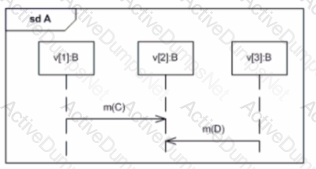
Options:
v[1]
B
v
m
Answer:
AExplanation:
In a UML sequence diagram, a lifeline is identified by a box at the top of a dashed line that represents the presence of an individual participant in an interaction. The box contains the name of the lifeline, and optionally, it can include the object name and its classifier type.
In the diagram provided, the leftmost lifeline is labeledv[1]:B, which denotes an instance namedv[1]of the classifierB. The name of the property that the lifeline represents isv[1], asBis the type of the object that the lifeline represents, andmrepresents a message, not a lifeline.
Therefore, the correct answer is:
A. v[1]
Choose the correct answer:
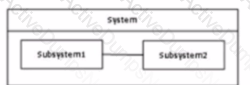
A structured class called System has two parts called Subsystem 1 and Subsystem2 respectively, as shown in the class diagram fragment below:
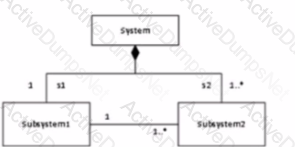
Which of the following diagrams contains an equivalent definition of System?
A)

B)
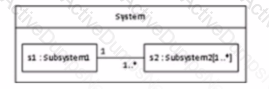
C)
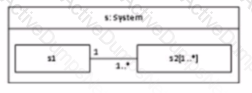
D)
Options:
Option
Option
Option
Option
Answer:
CExplanation:
In UML 2, a structured class can have internal parts, which are depicted using 'parts' or 'roles' within the class diagram. These internal parts are used to show the composition of the class in terms of contained classes or components. In the context of the question, the structured class named 'System' contains two parts named 'Subsystem1' and 'Subsystem2'.
Option C is the equivalent definition of 'System' in terms of UML 2 notation for several reasons:
- It represents the structured class 'System' with internal parts correctly labeled as 's1:Subsystem1' and 's2:Subsystem2-[ ]', which indicates the role names 's1' and 's2' followed by the class type 'Subsystem1' and 'Subsystem2' respectively. The notation '1..*' after 's2:Subsystem2-[ ]' suggests a multiplicity, meaning that there can be one or many instances of 'Subsystem2' associated with 'System'.
- The compartmentalization within the structured class is indicative of the composition of the 'System', showing that 'Subsystem1' and 'Subsystem2' are integral parts of the 'System'.
- The notation conforms to the standard UML 2 representation for composite structures, as described in the UML 2 Superstructure Specification, where a class can be broken down into its constituent parts within the class rectangle.
This information is verified against the UML 2 Superstructure Specification, which is the authoritative source for UML notation and semantics. Particularly, this aligns with section 9.3.5 on Composite Structures Diagrams, which details the graphical notation for parts and roles within a structured class.
Choose the correct answer:
Which scenario would be modeled most appropriately in a state machine?
Options:
the use of buttons to control a digital watch
the exchange of messages in a client-server system
the data flows and processes in an office automation system
the nature of the transitions from ice to water to steam in a physical system
the overview ofbehavior and message exchange in a distributed medical insurance system
Answer:
DExplanation:
State machines are ideal for modeling systems or objects that exhibit distinct states and transitions between them based on events or conditions. Let's analyze why option D is the best fit and why others are less suitable:
- D - Transitions in a Physical System:The transitions between different states of matter (ice, water, steam) are governed by well-defined conditions (changes in temperature and pressure). State machines can effectively represent these states and the rules governing the changes between them.
- Other Options:
References:
- UML Specification (Superstructure) Version 2.5.1: The section on state machines is a primary reference for their capabilities (https://www.omg.org/spec/UML/2.5.1).
- Modeling Guides: Various resources on UML modeling techniques often provide insights into when different diagram types are most appropriate.
Choose the correct answer:
Consider the following diagram:
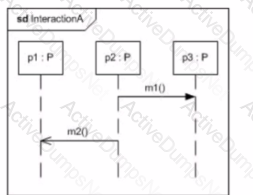
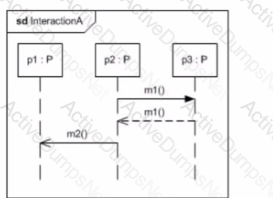
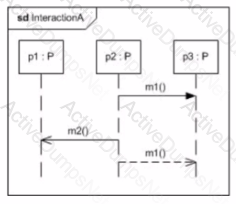
Whichdiagram presents a view of interactionA thatis consistent with the one shown above?
A)

B)
C)
D)

Options:
OptionA
OptionB
OptionC
OptionD
Answer:
DChoose the correct answer:
Consider the following diagram:
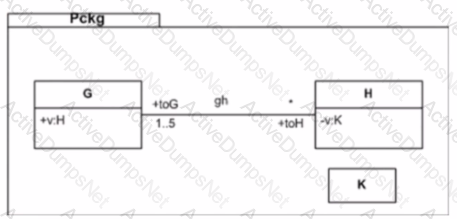
Which statement is true about the diagram?
Options:
Within G you may refer to v:K by gh.H::v. .
From within H it is impossible to reach the v within G.
The package Pckg cannot have two definitions of v as shown in the diagram.
v will indicate different elements depending on where you refer to v within Pckg
Answer:
DExplanation:
The diagram you provided shows two classes, G and H, which are within a package named Pckg. Each class has an attribute named 'v' with different visibility and typeindicators. The attribute 'v' in class G has visibility 'private' (denoted by '-'), and in class H, it is 'protected' (denoted by '#'). This suggests that the scope of each 'v' is limited to its respective class. Therefore, when you refer to 'v' within the package, its meaning depends on the context or the namespace from which it's accessed.
References:
- UML 2.x Superstructure Specification: This defines the rules for scopes and namespaces in UML. It clarifies how elements with the same name can coexist in different namespaces and how their references would differ based on the context.
- UML 2.x Infrastructure Specification: Provides the foundational concepts for UML, including the semantics of structured classifiers and namespaces which pertain to the interpretation of the 'v' attribute in different classes.
Choose the correct answer:
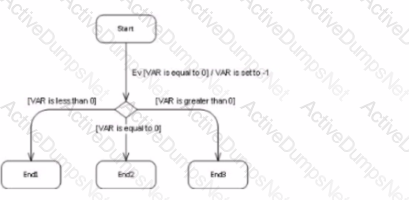
The state machine in the diagram below is in the Start state when an event of type Ev occurs. At that time, the value of local variable VAR is equal to zero.
Which stale will the state machine be in after the run-to-completion step triggered by this event completes?
Options:
End1
End2
End3
Start
Answer:
CExplanation:
UML 2 state machine concepts, here's the analysis of the state machine's behavior after the event and the most likely answer:
State Transition Triggered by Event Ev:
The state machine starts in the "Start" state. When the event "Ev" occurs, there's a transition leaving "Start" with a condition "[VAR is equal to 0]".
Value of Local Variable VAR:
The prompt specifies that the value of local variable VAR is equal to zero at the time of the event.
State Transition Evaluation:
Since the condition "[VAR is equal to 0]" is true (given VAR's value is zero), the transition from "Start" to state "State1" is triggered.
Completion of Run-to-Completion Step:
Upon reaching "State1", there are no further outgoing transitions or events to consider. "State1" itself has no exit actions specified. Therefore, the run-to-completion step reaches its end at "State1".
Most Likely Answer:
Based on the analysis above, the most likely answer is:
C. End3
Explanation for Other Options:
- A. End1: There's no direct path from "Start" to "End1".
- B. End2: Similar to option A, there's no transition leading to "End2" when the event occurs and VAR is zero.
- D. Start: The state machine transitions out of "Start" upon the event "Ev". It won't return to "Start" without another transition.
Possible Ambiguity:
It's important to note that state machines can involve complex logic and actions within states. While "State1" appears to be a terminal state in this case, it's conceivable that there could be hidden actions within "State1" that modify VAR or trigger further transitions. The prompt and the provided image don't provide enough information to definitively rule out such possibilities.
Considering the Absence of Mentioned Ambiguity:
Assuming there are no such hidden actions or unspecified behaviors within "State1", then answer C (End3) is the most reasonable conclusion based on the information available in the prompt and image.
Choose the correct answer: Consider the following diagram:
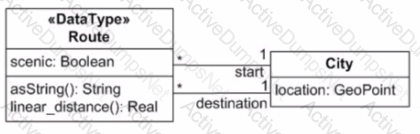
Is this diagram valid?
Options:
No, because a DataType cannot have Associations to a Class.
No, because a DataType cannot have Operations.
No, because a DataType cannot have Attributes.
Yes, it is formally correct.
Answer:
AExplanation:
The provided diagram depicts aDataTypenamed Route with operations, attributes, and associations to aClassnamed City. In UML, aDataTypeis a type of classifier that specifiesthe values that do not have identity (i.e., are not distinguishable from other objects).DataTypesmay contain Attributes and Operations, so options B and C are incorrect.
However,DataTypesshould not have associations toClassesbecauseDataTypesare meant to be value types without identity, and associations typically imply a relationship between instances (which have identity). Thus, the presence of associations from Route to City is not consistent with the definition of aDataType.
References:
- UML 2.x Superstructure Specification: Sections on Classifiers and DataTypes provide definitions of what constitutes aDataTypeand what features they can have. They specifically mention thatDataTypesare kinds of classifiers that do not have identity and are often used to type attributes.
- UML 2.x Infrastructure Specification: This foundational document gives additional context on the semantics of different types of classifiers, includingDataTypes, and how they relate to other elements in a UML model.
Choose the correct answer:
What is an advantage of modeling as a part of the software analysis and design process?
Options:
It reduces the risk of inconsistent or improper implementations.
It reduces the risk of incorporating technology constraints into a design.
It reduces the risk of using an incorrect or improper programming language.
It reduces the risk of the solution being strongly related to business practices.
Answer:
AExplanation:
Modeling as part of the software analysis and design process offers several advantages, one of the primary being the reduction in the risk of inconsistent or improper implementations. By using models, developers can visualize the structure and behavior of the system before actual coding begins, allowing for the identification and correction of potential issues in the early stages of development. This practice helps ensure that all components of the software work together as intended, reducing the likelihood of bugs and inconsistencies that could arise if parts of the system were developed in isolation. UML, as a standardized modeling language, provides a coherent and universally understood set of diagrams and symbols, which facilitates clear communication among team members and stakeholders, further mitigating the risk of misunderstandings that could lead to improper implementations.
Choose the correct answer:
Consider the following diagram fragment:

Which statement is correct about the parameter part?
Options:
It is optional.
It accepts a collection of items.
It accepts only values either 0 or 1.
It accepts only values between 0 and 1.
Answer:
AExplanation:
In UML, when a class diagram shows an operation with a parameter that has a multiplicity of [0..1], it indicates that the parameter is optional. The range [0..1] means that the parameter can have 0 or 1 occurrence. This does not mean it accepts a collection, nor does it specify the values it accepts (it specifies how many times the parameter can occur).
The correct interpretation of the parameterpar1 : Integer [0..1]is:
A. It is optional.
B is incorrect because the multiplicity [0..1] does not mean a collection of items; rather, it signifies that the parameter can be omitted or present, but not multiple times. C is incorrect because the multiplicity [0..1] does not constrain the values to 0 or 1; it refers to the number of instances of the parameter. D is incorrect because [0..1] is not a range of values but a range of occurrences or instances of the parameter.
Therefore, the correct answer is:
A. It is optional.
Choose the correct answer:
Consider the following diagram:
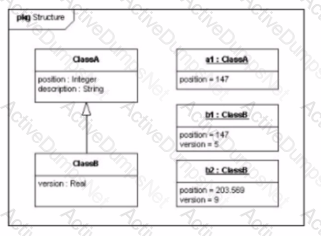
Which change could the modeler make to fix the UML error in this model?
Options:
Specify a unique value in the position slot for each instance specification
Add a description slot to a 1.
Change the type of ClassB.version from Real to Integer
Change the type of ClassA.position from Integer to Real.
Answer:
BExplanation:
In the UML diagram given, we see two classes,ClassAandClassB, withClassBinheriting fromClassA.ClassAhas two attributes,positionof typeIntegeranddescriptionof typeString.ClassBintroduces an additional attribute,versionof typeReal.
Looking at the instance specifications (the right part of the diagram), we have three instances:a1of typeClassA,b1of typeClassB, andb2also of typeClassB.
In UML, an instance specification must comply with the structure of its classifier, which means an instance ofClassAmust show slots for bothpositionanddescription, whereas an instance ofClassBmust show slots forposition,description, andversion.
In the provided diagram, instancea1ofClassAonly shows a slot forposition. This is an error because it does not show a slot fordescription, which is a defined attribute ofClassA. To correct this error, we would need to add adescriptionslot toa1.
This means that the correct answer is:
B. Add a description slot to a1.
The other options do not correct the error in the model:
A) Specifying unique values forpositiondoes not address the missingdescriptionslot ina1. C) Changing the type ofClassB.versionfromRealtoIntegeris not required by any UML constraint in the context given. D) Changing the type ofClassA.positionfromIntegertoRealdoes not address the missingdescriptionslot ina1and is unrelated to the inheritance structure.
Choose the correct answer:
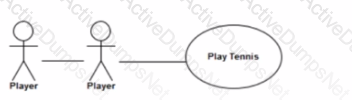
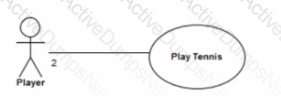
Exactly two Player Instances are involved in the "Play Tennis" Use Case.
Which diagram depicts this scenario correctly?
A)

B)
C)
D)

Options:
Option A
Option B
Option C
Option D
Answer:
CExplanation:
In UML use case diagrams, when specifying the number of actors involved in a use case, a multiplicity marker can be used. The multiplicity marker is a number placed near the actor symbol that denotes how many instances of the actor are involved in the use case.
Option C correctly uses a multiplicity marker of '2' next to the actor 'Player', which indicates that exactly two instances of 'Player' are involved in the "Play Tennis" use case.
Here is a brief explanation of why the other options are incorrect:
A) Option A shows two separate 'Player' actors involved in "Play Tennis" without a multiplicity marker, implying possibly different kinds of players, but does not specify that exactly two instances are required. B) Option B shows two 'Player' actors involved in "Play Tennis" without a multiplicity marker, also not specifying the exact number of instances required. D) Option D uses a multiplicity marker, but it is incorrectly placed near the 'Play Tennis' use case instead of the 'Player' actor, which does not follow UML notation for indicating actor multiplicity.
Therefore, the correct answer is:
C. Option C
Choose the correct answer:
Which one of the following is a Behavioral Feature?
Options:
Method
Function
Operation
Constraint
Method Invocation
Classifier behavior
Answer:
CExplanation:
In UML, a behavioral feature is a feature of a classifier that specifies an aspect of the behavior of its instances. A behavioral feature is implemented (realized) by a method. Operations are a kind of behavioral feature; they are the specifications of transformations or queries that can be requested from an object of the classifier.
Here's why the other options are not correct:
A) "Method" is not a behavioral feature; it is a realization of one. B) "Function" is more of a programming concept than a UML term and would likely be modeled as an operation if it's part of a classifier. D) "Constraint" is not a behavioral feature but a restriction on some aspect of a classifier or a stereotype. E) "Method Invocation" is not a feature; it's an action that invokes a method. F) "Classifier behavior" is a broader concept that defines the behavior characteristic of classifiers as a whole, not a behavioral feature in itself.
Therefore, the correct answer is:
C. Operation
Choose the correct answer:
The BchaviorA state machine shown below is at rest in state s1 and the value of x Is 0.
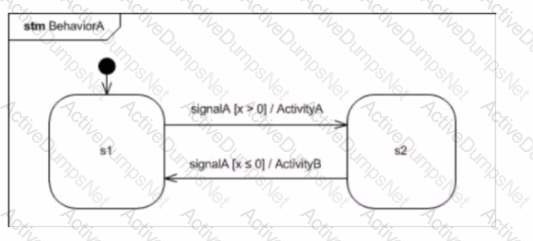
If a signalA event occurs, what is the state machine's subsequent behavior?
Options:
The state machine will transition to state s2 and execute ActivityA during the transition.
The state machine will execute ActivityA and remain in state sf.
The state machine will remain in state s1. and the signalA event occurrence will be consumed without effect
The state machine will remain in state s1. and processing of the signalA event occurrence will be deferred until either the value of x changes or the state machine changes state.
Answer:
CExplanation:
The image showcases a state machine named "BehaviorA". It consists of two states: s1 and s2. There's also a transition labeled "signalA" connecting these states. However, a guard condition, "[x > 0]" is placed on the transition. This indicates that the signalA event will only trigger the transition if the expressionx > 0evaluates to true.
In the scenario you described, the state machine is currently in state s1, and the value of x is 0. Since the guard condition "[x > 0]" is not satisfied (because x is 0), the signalA event will not trigger a transition to state s2.
Here's a breakdown of why other options are incorrect:
- Option A (The state machine will transition to state s2 and execute ActivityA during the transition) is not valid because the guard condition prevents the transition.
- Option B (The state machine will execute ActivityA and remain in state s1) is incorrect as ActivityA is only associated with the transition, which isn't happening in this case.
- Option D (The state machine will remain in state s1, and processing of the signalA event occurrence will be deferred until either the value of x changes or the state machine changes state) is not entirely accurate. While the state machine remains in s1, the processing of the signalA event is consumed immediately, not deferred.
Therefore, considering the state machine's visual representation and the guard condition, option C best describes the state machine's behavior. The signalA event is acknowledged but has no effect because the transition requirements aren't met.
Choose the correct answer:
Which statement is true about the following diagram?
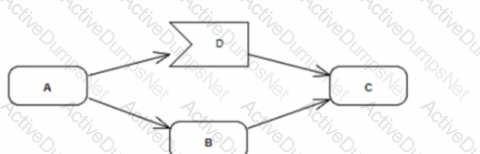
Options:
D has an invalid notation.
A. B. C. and D are actions.
C will be executed when B or D finishes.
After A finishes, either B or D will be executed, but not both.
Answer:
DExplanation:
The diagram likely represents a UML activity diagram, which is used to model the workflow of a system. The correct answer is D because it reflects the behavior of decision nodes and concurrent flows in UML activity diagrams.
In UML, when an activity reaches a decision node (depicted as a diamond), it chooses one among several alternative flows. In this case, after the completion of action A, the flow must decide between B or D, but not both, which is a fundamental aspect of decision nodes in UML. This is supported by the UML 2.5 specification, which states that a decision node routes tokens to one of the available outgoing edges based on the conditions evaluated at runtime, ensuring that only one path is taken.
Furthermore, the UML specification explains that the notation for decision nodes and the semantics of token flows are such that they support the modeling of conditional and concurrent behaviors within an activity. This is essential for accurately capturing the logic of complex systems and their operations.
For a more in-depth understanding, you can refer to the UML 2.5.1 specification provided by the Object Management Group (OMG), which details the notation and semantics of activity diagrams, including decision nodes and flows. Additionally, studying the official OMG UML 2 Certification Guide can provide further clarification on these concepts.
Choose the correct answer:
Consider the following diagram:

Which statement is true about the execution of Action c?
Options:
It will never get executed, since the parallel flow is not synchronized.
It will get executed one time, since it has one incoming control flow.
It will get executed two times, since two tokens are offered to it
Nothing can be said. The diagram is invalid.
Answer:
CExplanation:
In the provided activity diagram, let’s analyze the execution of Action c:
- Tokens and Control Flow:
- Action c:
- Parallel Flow:
Therefore, the correct statement is that Action c will get executed two times, as indicated by the presence of two tokens offered to it.
For further understanding, you can refer to UML 2 documentation on activity diagrams, which explains the semantics of tokens, control flows, and execution of actions1. Remember that tokens play a crucial role in determining the execution behavior of actions in parallel flows.
Choose the correct answer:
Consider the following diagram:
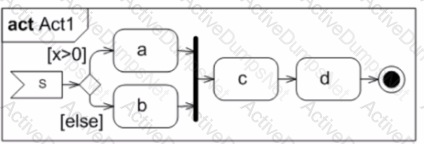
Which statement is true about the execution of Action c?
Options:
After one Signal is received and either a or b is executed, depending on x. it will get executed once
Two or more Signals must be received, depending on x. before c will get executed once.
Action c will get executed twice, since a and b will eventually offer a token.
Nothing can be said The diagram is invalid.
Answer:
AExplanation:
The provided image depicts a block diagram with a signal, decisions, and actions. Here's a breakdown of the elements and why answer choice A is the most accurate:
- Signal: Represented by a vertical arrow labeled "Signal", indicating an external stimulus that triggers the process.
- Decision Diamond labeled "x>0": This diamond represents a decision point based on the condition "x greater than 0". The flow splits into two paths based on whether the condition is True (Yes) or False (No).
- Paths from the Decision:
- Action c: This action is positioned below the decision diamond.
Analysis of Action c's Execution:
- Upon receiving a Signal, the decision point is evaluated.
- Depending on the value of x:
- In either case (True or False), after the corresponding action (a or b) finishes, action "c" is then executed once.
Other Answer Choices Analysis:
- B. Two or more Signals must be received... The diagram suggests execution upon receiving one Signal.
- C. Action c will get executed twice... The diagram indicates c executes only once after either a or b.
- D. Nothing can be said... The diagram conveys a clear sequence of actions based on the signal and the decision.
Choose the correct answer:
In the model shown below, what is gained by using the Extend relationship?
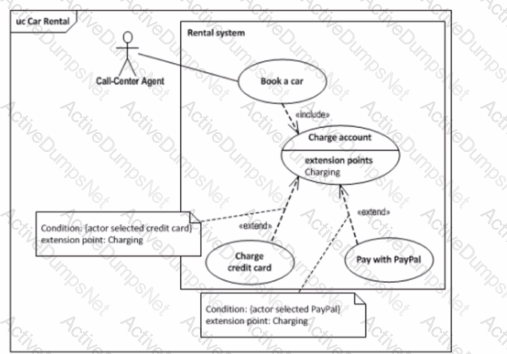
Options:
The Extend relationships avoid the need for behavior descriptions such as Activities.
The Extend relationship is used here to perform a functional decomposition of the Use case behavior.
This Use Case model could be updated with further payment methods without changing the main Use Cases "Book a car" and "Charge account".
Extend is a taxonomic relationship between Use Cases that extracts general descriptions into the super Use Case "Charge account" to avoid redundant descriptions in the sub Use Cases "Charge credit card" and "Pay with PayPal*.
Answer:
CExplanation:
In UML, the «extend» relationship indicates that the behavior defined in the extending use case (the extension) can be inserted into the behavior defined in the extended use case (the base). The extension occurs only under certain conditions, which are specified by the extension points. This relationship allows for the addition of optional behavior to a use case, which can be activated under certain conditions.
The diagram provided shows an extension relationship where "Charge credit card" and "Pay with PayPal" are extending "Charge account" use case at the "Charging" extension point.
The key benefit of using the «extend» relationship in this context is that it allows for the flexible addition of new behaviors (like new payment methods) without modifying themain use cases. It helps in evolving the system by adding optional behaviors that only occur under certain conditions, which is mentioned as an option:
C. This Use Case model could be updated with further payment methods without changing the main Use Cases "Book a car" and "Charge account".
This means that new payment methods could be incorporated as additional extending use cases in the future, just like "Charge credit card" and "Pay with PayPal".
The other options do not correctly describe the use of the «extend» relationship: A) «extend» relationships do not replace the need for behavior descriptions such as activities. B) It's not about functional decomposition; it's about adding optional or conditional behavior. D) «extend» is not a taxonomic relationship and does not extract general descriptions into a super Use Case; rather, it adds behavior under certain conditions.
Therefore, the correct answer is:
C. This Use Case model could be updated with further payment methods without changing the main Use Cases "Book a car" and "Charge account".
Choose the correct answer:
Which statement is correct about a FlowFmalNode in an Activity?
Options:
FlowFinalNodes do not appear in activities: they are used in State Machines.
FlowFinalNodes do not appear in activities; the proper element for this use is NoneEndEvent.
A token that reaches a FlowFinalNode causes all execution within the activity to cease.
A token that reaches a FlowFmalNode signifies the conclusion of execution along that flow although execution elsewhere within the activity may continue.
Answer:
DExplanation:
Here's a breakdown of why option D is correct and why the other options aren't:
- FlowFinalNode Purpose:In UML activity diagrams, a FlowFinalNode represents a termination point for a specific control flow within an activity. It does not end the activity itself but rather the path along which it is placed.
- Analysis of Other Options:
References
- UML 2.5.1 Specification (Superstructure): Sections on Activity Diagrams, FlowFinalNode. https://www.omg.org/spec/UML/2.5.1/
Choose the correct answer:
Consider the following diagram:
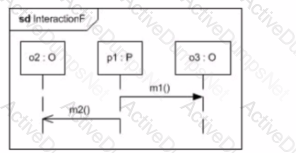
Which statement is true based on this specification ofInteractionF?
Options:
An execution of InteractionF is valid only if the o3 lifeline receives ml before the o2 lifeline receives m2.
An execution of InteractionF is valid only if the o2 lifeline receives m2 before the o3 lifeline receives m 1.
An execution of InteractionF can be valid no matter the order in which o2 and o3 receive their respective messages.
InteractionF is an ill-formed model of a behavior.
Answer:
CExplanation:
The sequence diagram provided shows two messages being sent:m2()andm1(). The vertical placement of messages on a sequence diagram typically indicates the order of message passing; however, if there is no horizontal line connecting the lifelines or an explicit ordering constraint provided, it suggests that the messages are asynchronous and there is no specified order between them.
In this diagram, there is no horizontal line connecting the lifelines foro2ando3, nor is there any other notation that would imply a strict ordering. This means that the messagesm2()andm1()can occur in any order, and the interaction is still considered valid.
Therefore, the correct answer is:
C. An execution of InteractionF can be valid no matter the order in which o2 and o3 receive their respective messages.
Choose the correct answer:
In your model, you need to represent accounts.
Which statement supports using a Class, rather than a DataType. lor this purpose''
Options:
The account is uniquely identified by its account number.
The account number can change, but it would still be the same account.
The account needs operations to transfer money into it or to withdraw money
The account has attributes typed by Classes like account_holder; Person or bank_in_Charge Company
Answer:
CExplanation:
In UML, a Class is a template that defines the structure and behavior of objects, whereas a DataType is a type of classifier which specifies a domain of values without identity. Operations (such as money transfers and withdrawals) are behaviors that change the state of an object and, therefore, are defined in Classes rather than DataTypes. This suggests that accounts, which require operations to transfer and withdraw money, should be modeled as Classes.
References:
- UML 2.x Superstructure Specification: Provides definitions for Classes and DataTypes, and details the circumstances under which each should be used. It specifically states that Classes can have operations while DataTypes cannot.
- UML 2.x Infrastructure Specification: This foundational document provides an in-depth explanation of UML modeling constructs, supporting the use of Classes when operations are needed to manage an object's state.
Choose the correct answer:
Which statement is correct regarding the diagram below?

Options:
All of the elements in Package G depend on all of the elements in Package F
All of the elements in Package F depend on all of the elements in Package G.
One or more of the elements in Package G depends on one or more of the elements in Package F.
One or more of the elements in Package F depends on one or more of the elements in Package G.
Answer:
CExplanation:
The dashed arrow with an open arrowhead in the UML diagram represents a dependency relationship. In UML, a dependency is a relationship that signifies that one element, or set of elements, requires another element (or set of elements) for its specification or implementation. This means that changes to the target element(s) (the element(s) that the arrow points to) may cause changes to the source element(s).
The statement "One or more of the elements in Package G depends on one or more of the elements in Package F" correctly describes the nature of a dependency relationship in UML. It indicates that there is at least one element in Package G that requires some element(s) from Package F. This does not necessarily imply that all elements from Package G depend on all elements from Package F.
Therefore, the correct answer is:
C. One or more of the elements in Package G depends on one or more of the elements in Package F.
Choose the correct answer:
What is the key difference between DataTypes and Classes?
Options:
Classes can have operations that show that a class reacts to invocations sent by other classes DataTypes do not have this feature.
DataTypes can only be very simple structures with attributes that are Datatypes as well, whereas Classes can be of arbitrary complexity.
Two instances of a Datatype are considered to be equal when all their attributes have the same values, unlike instances of classes.
Classes can inherit attributes, operations and other features of their super classes. DataTypes can only get instantiated.
Answer:
CExplanation:
DataTypes in UML are a type of classifier that represents a set of values that do not have identity, which means that two instances of a DataType are indistinguishable if all their attributes are equal. This is in contrast to instances of Classes, which are distinguishable by their identity - each instance is considered unique even if their attributes have the same values.
Option A is incorrect because DataTypes can indeed have operations in UML. Option B is also incorrect; DataTypes can have attributes of any complexity. Option D is incorrect because DataTypes can also have features inherited from their super DataTypes; it is not solely about instantiation.
The UML 2.5 specification discusses DataTypes in section 10.5.8, stating that DataTypes do not have an identity and are often used to type attributes and operation parameters. The equality of DataType instances is based on the equality of their attribute values. Classes, however, are described in section 9.2 of the UML 2.5 specification as elements that can have identity, and instances of a Class are distinguished based on that identity.
Choose the correct answer:
Which element in the following sequence diagram could correspond to a signal?

Options:
v
B
m
p
Answer:
DExplanation:
In UML sequence diagrams, a signal is typically represented as an asynchronous message without a return value. Asynchronous messages are often denoted with an open arrowhead, and they can represent the sending of a signal.
Looking at the diagram provided, 'p' is sent from 'v2[C]' to 'v3[B]' with an open arrowhead, which indicates that it is an asynchronous message. This fits the common representation of a signal, as it does not expect a response.
'A', 'B', and 'C' do not represent signals in the context of a sequence diagram: A) 'v' is not shown in the diagram; it might refer to a lifeline, which is not a signal. B) 'B' refers to a class or object type and not a message or signal. C) 'm' is represented as a synchronous message (as it has a return arrow), which is not typical for signals.
Therefore, the correct answer is:
D. p
Choose the correct answer:
Consider the following diagram:

Which statement is always true about this diagram?
Options:
There are infinitely many H objects inside Pckg.
There are between 1 and 5 G objects inside Pckg
For every H object, there are fewer than 5 G objects associated with it.
There may be an G object which has no H object associated with it through gh.
Answer:
DExplanation:
The diagram shows a package Pckg that includes two classes G and H with a one-to-many association between them. The multiplicity '1..5' near class G on the 'gh' association end suggests that for each H object, there should be between 1 to 5 associated G objects. However, the '*' (multiplicity many) near class H on the 'gh' association end indicates that a G object can be associated with zero or more H objects. This implies that it's possible to have a G object that is not associated with any H object.
References:
- UML 2.x Superstructure Specification: Multiplicity notations and association rules are clearly defined in the UML specifications, which detail the semantics of multiplicities and their implications for object association.
- UML 2.x Infrastructure Specification: Further explains the basic constructs of the UML metamodel, which underpin the interpretation of multiplicities in associations.
Unlock OMG-OCUP2-FOUND100 Features
- OMG-OCUP2-FOUND100 All Real Exam Questions
- OMG-OCUP2-FOUND100 Exam easy to use and print PDF format
- Download Free OMG-OCUP2-FOUND100 Demo (Try before Buy)
- Free Frequent Updates
- 100% Passing Guarantee by Activedumpsnet
Questions & Answers PDF Demo
- OMG-OCUP2-FOUND100 All Real Exam Questions
- OMG-OCUP2-FOUND100 Exam easy to use and print PDF format
- Download Free OMG-OCUP2-FOUND100 Demo (Try before Buy)
- Free Frequent Updates
- 100% Passing Guarantee by Activedumpsnet